

05 Nov
2026
Last Updated: November 5, 2026
Quick Summary
The core minimalist wardrobe essentials for creative professionals are a structured layer, a versatile pair of trousers or jeans, everyday neutral tops, a layering tank, statement-free pieces, comfortable footwear and transitional outerwear. A working capsule of roughly 25 to 40 pieces, including shoes and outerwear, covers a month of varied settings.
Creative professionals dress for two audiences at once: clients who expect polish and studio days that demand comfort and movement. A minimalist wardrobe can serve both, but only if you build it around how your week actually runs. Shop For Better created this guide to help you choose minimalist wardrobe essentials for creative professionals who want fewer pieces that work harder.
Most generic capsule advice assumes a corporate office with fixed dress codes. Creative work is messier. A photographer may shoot outdoors in the morning, sit in a client review by afternoon, and attend a gallery opening that evening.
The practical goal is not owning less for its own sake. It is owning fewer pieces that combine well, so getting dressed takes less thought and every item gets worn.
Quick Picks: Start with one structured layer, one versatile bottom, and two neutral tops you can wear in any setting. Build outward from that core rather than buying a full wardrobe at once.
Think of these seven categories as the foundation of your capsule. Each one should earn its place by working across at least two of your regular settings.
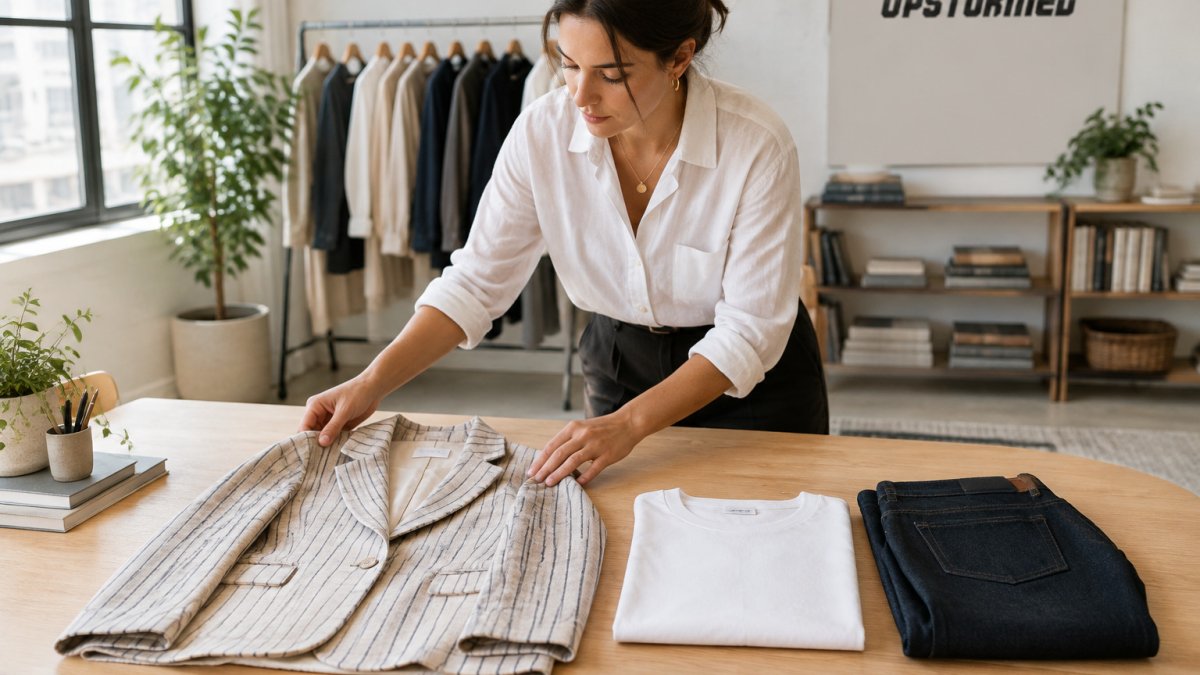
Your first purchase should be the structured layer, since it changes how every other piece reads.
A blazer is the piece that signals professionalism in a creative setting without making you look like you are headed to a bank. Look for a lightweight construction, which keeps it comfortable on the go.
The Love Tree Linen Woven Striped Blazer, priced at $38.14, suits warmer months. It is made from 55% linen and 45% viscose, and its product listing describes it as lightweight and breathable.
Watch out: a blazer that fits badly at the shoulders will look worse than no blazer at all. Check the shoulder and sleeve measurements before you buy, not just the size label.
The Basic Bae Wide Leg Pocketed Pants at $42.00 feature pockets and a wide-leg silhouette, and they pair with a blazer for a range of occasions. The Judy Blue Full Size High Waist Straight Jeans at $64.50 are a denim option with a high waist and straight leg.
Judy Blue Full Size High Waist Straight Jeans →
If you want a slimmer line, the YMI Jeanswear Full Size Hyperstretch Mid-Rise Skinny Pants at $38.32 are made with a stretch blend. Check the product measurements for rise and inseam against a pair you already own that fits well.
There is no universal number, but most creative professionals find that a working capsule of roughly 25 to 40 pieces, including shoes and outerwear, covers a month of real settings without repeating outfits too often. If you are sizing one on a limited budget, see practical guidance on building a capsule wardrobe on a budget.
A practical breakdown for a creative schedule looks like this:
Count by outfit combinations rather than individual items. Ten pieces that mix into 30 workable outfits beat 20 pieces that only pair two ways.
Seasonality is the other variable. In warmer months, swap the heaviest knit and the cold-weather coat for a linen layer and a lighter overshirt rather than adding a parallel summer wardrobe. In colder months, add one base layer and one outer layer and rotate the lightest pieces out.
Watch out: the 25-to-40 range assumes you do laundry weekly. If you wash less often, either add two or three base layers or accept a tighter rotation rather than buying a second full capsule.
The article breaks a working capsule into category counts that add up to a realistic total.
| Category | Recommended count | Note |
|---|---|---|
| Total capsule | 25 to 40 pieces | Includes shoes and outerwear |
| Tops | 8 to 10 pieces | Plain tees, knit tops, two button-front shirts |
| Bottoms | 4 to 5 pieces | Two trousers, one dark denim, one relaxed pant |
| Structured layers | 2 to 3 pieces | One lightweight, one warmer |
| Base layers | 3 to 4 pieces | Tanks or long-sleeve bases |
| Footwear | 3 pairs | Sneaker, loafer or flat, boot |
| Outerwear | 2 pieces | One transitional, one cold-weather |
Remote and hybrid schedules change what you need. Home days call for comfortable, washable pieces, while office or client days need a structured layer. A simple test: can each piece move between home and a client room with at most one swap?
The Zenana Round Neck Long Sleeve T-Shirt at $27.84 and the Culture Code Full Size V-Neck Long Sleeve T-Shirt at $24.00 both work as everyday base layers.
Many remote workers find that dressing for the first hour of their day makes the rest of it easier to manage. Keep at least one piece that feels like a professional choice even on days you do not leave the house.
Use this checklist before buying anything new, and again at the start of each season.
Pull everything out and sort into three piles: wears weekly, wears occasionally, and has not been worn in six months. The third pile is the one to address first. A common pattern is that unworn pieces fail for one of four reasons: they do not fit, they need a repair, they only work in one setting, or they were bought for a version of your week that no longer exists. Repair and tailoring are usually cheaper than replacement, and a hem or a waist adjustment can rescue a piece that otherwise reads as clutter.
Judy Blue Full Size High Waist Straight Jeans →
Before you buy anything new, photograph the keep pile and note the gaps. Buying against a written gap list is the single biggest defense against impulse purchases that break the capsule.
Minimalism only pays off if the pieces last. Care instructions vary by fiber, and treating every item the same shortens its life.
Store structured layers on broad hangers to hold the shoulder line, and give knits shelf space. Rotate shoes so each pair has a day to dry out, which extends the life of the sole and interior more than any cleaning product.
Watch out: dry-clean-only labels on a blazer often mean the lining, not the shell, so spot-clean and air the piece between wears rather than sending it out every week.
A minimalist wardrobe does not have to look flat. Stick to a neutral base, such as black, white, grey, navy or cream, and add personality through one accent color or a striped piece like the Love Tree blazer. To see how different colors shape the impression your clothes make, read how to use color psychology in fashion. Texture, such as linen against knit, adds interest without adding pieces.
Limit your palette to three or four colors so everything combines. Rotate accessories rather than clothing if you want more variety from the same base.
Do not try to build the full capsule at once. Choose three pieces: one structured layer, one bottom, and one everyday top. Wear them together for a week across your real settings and note where you feel underdressed or constrained.
Upstormed offers pieces that fit several of these categories, so you can build part of your capsule from one place. Shop the collection to begin with your first three items and add the rest as your schedule demands.
A workable minimalist core usually includes a tailored blazer, well-fitted trousers or straight jeans, a few neutral basic tops, a long-sleeve layer, and one versatile tank or tee for layering. For creative professionals, add one piece with a distinctive detail, such as a striped or textured layer, so the wardrobe reads as personal rather than generic. Keep every piece in a coordinating palette so any top works with any bottom, which is what keeps the number of pieces small while outfits stay varied.
Most capsule plans land between 25 and 40 pieces, counting tops, bottoms, layers and dresses but usually excluding shoes, accessories and workout clothes. The exact number matters less than whether every piece combines with at least three others. Start with a smaller working set of 20 to 25 pieces if your job is mostly office based, then add a few statement items once you see which combinations you wear most often.
Begin by sorting everything you own into keep, donate and unsure piles. Then list the categories you need for your week: workdays, client or studio days, and off-hours. Check each category against the pieces you keep and mark gaps, such as a missing layer or a bottom that fits well. Finally, write down your neutral palette and two accent colors, and only buy items that fit both the list and the palette.
Neutrals such as navy, charcoal, camel, cream and black form the base because they mix freely. Add one or two accent colors you already wear, which keeps the wardrobe feeling personal without increasing the number of combinations you must plan around. A striped linen blazer, for example, works with the neutral base and brings a subtle pattern that many creative professionals find useful in client-facing settings.

Winter sweater styles for a minimalist wardrobe, from cable knits to cardigans, with tips on fabr...

Straight leg versus bootcut jeans: compare fit, balance, styling, and shoe pairings to choose the...

Build your daily confidence jewelry around metals, styles and layers that suit you, so each piece...

 Account
 Cart
