Black Friday to Cyber Monday: free shipping on $100+, 20% off orders over $150


17 Nov
2026
A label can’t prove your leggings will stay opaque under a loaded squat. A squat-proof leggings test for heavy lifting should include stretching the fabric over your knuckles, then squatting to full depth in bright light and checking the seat and backs of the thighs for show-through. For heavy lifting, look for a dense fabric in the 200–300 GSM range, but judge the fit and coverage on your body too.
It’s worth looking beyond how leggings appear when you’re standing still. Fabric stretches under load, and fit, sweat, washing, and seam construction can all affect how it performs. A practical squat-proof leggings test for heavy lifting checks those details in motion.
This guide explains how to assess fabric weight, stretch, and knit, then check fit, waistband stability, and seams. You’ll also learn how to repeat the test after wearing and washing the leggings, so you can judge whether they’re comfortable and stay covered when you lift.
Choose a dense polyester-nylon blend with 20–30% spandex, plus reinforced panels or extra layers at the seat and thighs. This construction can balance opacity under stretch, flexibility, and durability through a deep squat.
Start with fabric density, measured in GSM. For heavy lifting, a useful target is 200–300 GSM; fabric below 180 GSM is typically too thin for loaded squats. Fabric weight can offer a useful comparison, but it does not by itself determine whether leggings stay opaque under stretch. These ranges guide your choice, but the final test is whether the fabric stays opaque when stretched over your body.
Thickness alone doesn’t determine coverage. A single layer can thin and lose opacity under tension, even if it feels substantial at rest. Dense fabric, reinforced panels in high-stress areas, or extra layers at the seat and thighs may help maintain coverage. Check those areas during a deep squat, when the fabric stretches across the glutes and upper thighs.
Color also matters. Light-colored leggings need particularly dense fabric; look for 240 GSM or higher. Darker fabric may make show-through less noticeable, but color can’t replace a stretch test. Check the leggings under bright light, since the contrast between skin, underwear, and fabric can reveal what a quick glance misses.
Fiber names are useful clues, not a guarantee. A dense polyester-nylon blend is recommended for maintaining opacity during a deep squat, while 20–30% spandex can help balance coverage with a full range of motion. For CrossFit transitions, leggings with 20–25% spandex typically provide the flexibility needed for varied movement. Pure cotton blends absorb moisture and lose elasticity under load, so they may feel less dependable as training intensifies.
If you sweat during training, look for moisture-wicking fabric. It moves moisture away to help keep you dry, but that feature doesn’t prove the leggings will stay opaque during a squat. Check coverage before movement and again when the fabric is damp, especially across the seat and thighs.
Read the fiber label, then treat it as a starting point. According to the Federal Trade Commission, fibers making up less than 5% are disclosed as “other fiber.” That label rule helps explain why a smaller fiber may not appear by name. It doesn’t tell you how the finished knit performs under tension, so judge the material and construction together.
The best fit for your workout stays opaque without restricting movement. Compare fabric density, shade, stretch, and construction, then include a deep squat in your assessment. For lifting and CrossFit, coverage and flexibility both matter.
Check the leggings in bright light while standing and at the bottom of a deep squat. Look behind you in a mirror for visible skin tone or underwear at the seat and backs of the thighs. These positions stretch the fabric across your body, where coverage can change.
A knit’s appearance at rest can be misleading. Its loops may open as the fabric stretches, letting more light through. A smooth-looking surface while standing doesn’t establish opacity during movement. Check how the material behaves under tension, not just how it looks before you move.
Research from Donghua University examined light transmission in three plain-knit fabrics made for seamless sportswear. The example illustrates why knit structure matters alongside fiber content. Different knits can respond differently when stretched, so a label that names elastane alone can’t tell you how much light will pass through.
Before buying, hold a section of fabric over your hand and stretch it gently toward a bright window or light. If your skin tone or the outline of your hand becomes clearly visible, treat that as a warning sign. If the fabric’s construction varies, repeat the check over the seat area.
Then test the leggings on your body. Under bright light, do a deep squat and check the seat and thighs from behind. You can also stretch a hand or knee beneath the fabric to see how much light passes through. A clear outline shows what standing still may not reveal.
The fabric should support movement without visibly opening up. Try a deep squat, then stand, hinge forward, and step into a lunge. Notice if the fabric pulls sharply, shifts, or stays stretched instead of returning smoothly. These movements expose different points of tension around the hips, thighs, and knees.
Check retention with repeated movement, not a single pose. A guide recommends 100 bodyweight squats to assess whether leggings retain their fit. After the repetitions, look for slipping, sagging, or new show-through across the seat and thighs. The goal isn’t to chase a perfect-looking pose. It’s to see whether the knit stays covered through movement.
Use the same light and positions whenever you compare leggings. A bright window, mirror, hand-stretch check, and full-depth squat make a consistent routine. This helps you spot fabric that looks opaque at rest but becomes revealing under tension before relying on it for heavy lifting.
Yes. Stretch can thin fabric, and wear can reduce opacity; sweat and moisture can also change how the fabric looks against your skin. Test the leggings in the fit you plan to lift in, then reassess them after use and washing.
Size affects the tension across the seat and thighs. If leggings feel strained while standing, they may stretch further in a deep squat. If they sag or shift, the fit or waistband may not stay in place during movement. Squat in front of a mirror and check whether the fabric pulls smooth, wrinkles, or reveals your skin tone.
Look beyond the size label. Two pairs in the same size can fit differently because their fabric and cut differ. Check that the waistband stays secure without digging in or sliding down as you bend. Then assess the seat and thighs at the bottom of a squat, where tightness can make fabric appear more transparent.
Wear gives you a more realistic picture than a first try-on. Repeated movement can stretch high-stress areas and affect opacity over time. After wearing the leggings a few times, repeat the mirror check in the same bright light and deep-squat position. Compare the seat and backs of the thighs with their appearance when new.
Washing can also affect the fabric. Assess the leggings after a few washes, following the care instructions on the label. Don’t assume a pair that passed its first fitting will maintain the same coverage indefinitely. As part of routine care, recheck the fit, waistband, and opacity.
Sweat is another condition to consider. Moisture can change how fabric looks, especially where it’s stretched across the body. After a workout, check whether damp areas look more revealing than they did when dry. Moisture-wicking fabric moves moisture away during training to help keep you dry, but that feature alone doesn’t establish squat coverage.
A consistent routine makes changes easier to spot. Check the leggings dry and after training, using the same mirror, lighting, and deep squat each time. Look for changes in show-through, fit, or waistband position. If the leggings stay opaque and in place in both checks, you have a more reliable basis for judging their performance.
Care matters, but it can’t reverse fabric wear. If leggings become visibly sheer, sag at the seat, or no longer stay in place, their original fit doesn’t prove they still provide coverage. Check the fabric’s current condition before heavy lifting and use what you observe to guide your decision.
A gusset changes how fabric sits where the thighs meet. For lifting, inspect its shape, placement, and stitching before judging comfort or coverage. A diamond gusset extending at least 2 inches toward the front and back is recommended for reinforcement. That added panel distributes tension across a broader area during movement.
Check the gusset while standing, then repeat in a deep squat and forward hinge. Notice whether it stays centered or pulls sharply toward the crotch. If the fabric twists, bunches, or feels strained between the thighs, movement may add tension to the crotch seams during training.
Inspect the seam construction closely. Turn the leggings inside out and check the stitching around the gusset, crotch, and inner thighs. Look for loose threads, uneven joins, or gaps between stitches. These visible signs can reveal weak construction before a hard session puts the area under repeated stress.
Next, try a squat, lunge, and hinge. Notice any pinching, rubbing, or pulling at the seams. Compression should feel supportive without restricting movement. A seam that feels comfortable while standing may press or rub when your thighs bend and separate in a deep squat.
Buying decisions involve more than the price on the tag. A lower price doesn’t prove seams will last, and a higher price doesn’t establish durability. Compare construction details instead, such as a reinforced gusset, even stitching, and fabric that moves without pulling. Consider whether those details suit your training and how often you expect to wear the leggings.
Care also affects how the garment holds up. Follow the washing and drying instructions on the label, and inspect the gusset and crotch seams after washing. Look for fraying, loose threads, or stitches starting to separate. Ignoring care instructions repeatedly can put unnecessary strain on fabric and seams.
During a workout, friction and repeated movement put stress on the inner thighs and crotch. Check those areas after each session before putting the leggings away. Spotting a loose thread early helps you notice a change before it becomes a visible gap or a seam that no longer lies flat.
Use the same quick inspection each time: check the gusset’s shape, examine the seam inside, then test a squat and hinge. A reinforced panel can support durability, but fit and stitching matter too. Choose leggings that let you move freely without sharp pulling at the crotch or inner thighs.
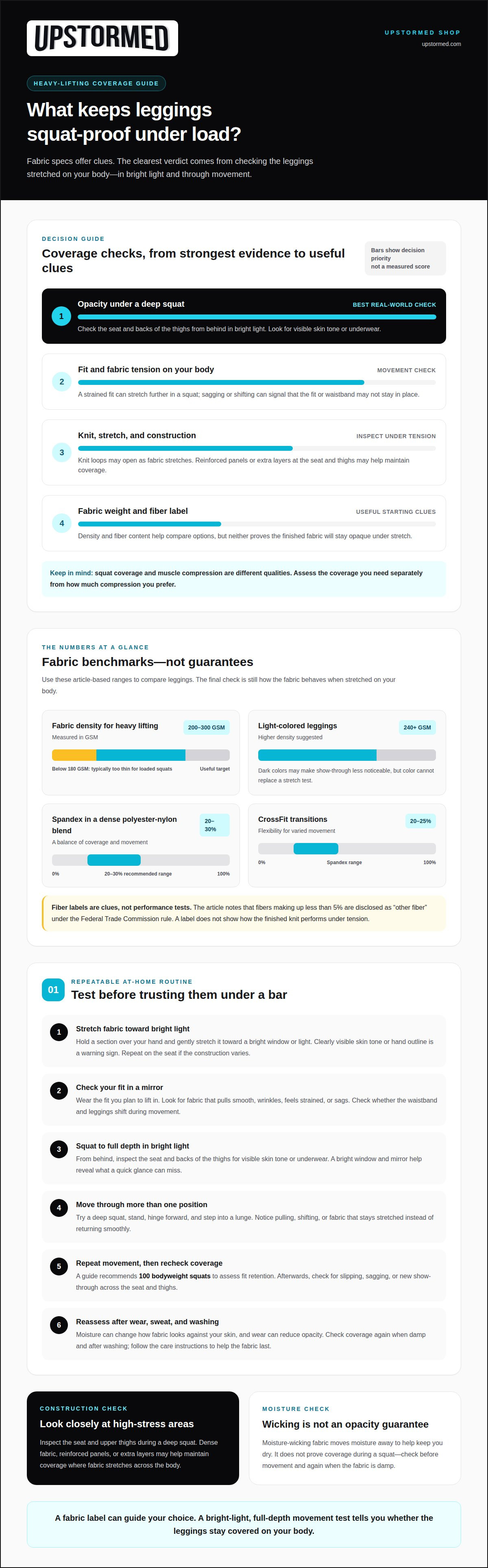
Test leggings under tension, in bright light, and through repeated movement. A squat-proof leggings test for heavy lifting should reveal any show-through across the glutes, changes in fit, or fabric that doesn’t return smoothly.
Set aside ten minutes for an at-home check. Use a bright room, a full-length mirror, and a brightly colored underlayer to make show-through easier to spot. Test the leggings in the size you’ll actually wear, since fit affects how much the fabric stretches across your body.
Judge what you see, not just what you feel. Leggings may feel comfortable while standing but reveal more when stretched across the glutes. If coverage changes during squats or the waistband shifts, don’t treat the first fitting as a pass for heavy lifting. Repeat the test after a few washes to assess how the fabric holds up.
Ready to put your next pair through a real movement check? Explore yoga fitness leggings, then use this ten-minute routine to assess fit and coverage before lifting.
Upstormed Shop offers yoga fitness leggings for readers looking for activewear to assess for fit and coverage. Use the fabric, movement, and wear tests in this guide to decide whether a pair suits your lifting routine. Don’t assume the product category alone guarantees squat-proof coverage.
Before a heavy session, assess the leggings in bright light, then do a deep squat and check how the fabric sits across the seat and thighs. This gives you a practical way to judge whether a pair suits your movement needs. Choose with confidence, using your test to guide the decision.
For questions about the offering, contact Upstormed Shop.
The right choice supports your movement and helps you feel ready to train. Let your own squat check guide your next step instead of relying on appearance alone. A squat-proof leggings test for heavy lifting can help you decide what belongs in your training rotation.
Upstormed Shop offers yoga fitness leggings alongside Ripped Slimming Jeans For Women and a Sexy See-through Hollow Beach Dress for Women. Each suits a different place in a wardrobe, so choose according to the activity and look you want. For lifting, focus on the leggings and test them through the movements that matter to you.
Have a question about the shop’s offerings? Contact Upstormed Shop. Keep moving with intention, trust what you learn from each test, and choose what helps you feel strong.
The best pair is one that stays in place and maintains coverage during your own lifting movements. Before committing to a training rotation, wear the leggings through a warm-up, then check comfort during a squat, hinge, and lunge. Notice whether the fabric distracts you, shifts, or restricts your stride. A useful choice supports the session you actually do, not just a pose in front of a mirror.
No. Thickness alone can’t tell you whether leggings will stay opaque when stretched. Fabric may feel substantial between your fingers but become more revealing when pulled across the hips. Knit construction, fit, and the fabric’s response to tension matter too. Treat a dense feel as one clue, then judge coverage in the positions you’ll use for training.
Start with a secure fit and a waistband that stays anchored as you bend. A waistband at least 3–4 inches tall can help; a wide, structured band with a drawstring or internal grip is designed to stay anchored. During a bodyweight squat, notice whether the band folds or slides. If you need to pull it back into place repeatedly, it may disrupt your set.
Neither construction guarantees better lifting performance. Seamless leggings use a knit construction with fewer joined seams, while cut-and-sew garments are assembled from fabric panels with seams. Either can work if the garment fits comfortably and holds up through your movements. Check how seams feel during a lunge and whether panels pull across the hips. Let fit and construction quality guide your choice.
Squatting stretches fabric across the glutes and thighs, which can reduce coverage if the knit opens under tension. A size that feels too tight may increase that pull, while repeated wear can change the fabric’s condition. For a quick clue, compare how the seat looks standing and at the bottom of a squat. A change in visible skin tone signals reduced opacity.
Choose based on how the leggings perform in your training, not a year-specific trend or product label. Try your usual warm-up movements, a deep squat, and the stance you use for deadlifts. Check comfort and coverage after moving, not just before your workout. If the leggings shift or distract you during those movements, they may not suit your lifting routine.
They can, but coverage depends on the fabric’s stretch and how the garment fits in each position. A deep squat stretches the seat; a lunge bends one leg while extending the other; a deadlift hinge tests the fit around the hips and thighs. Try each movement separately under bright light. Passing one position doesn’t establish coverage through the others.
Choose a size that lets you move without pulling the fabric taut across the seat or thighs. Don’t size down just to create a tighter feel; excess tension can make coverage less dependable. Try a squat and lunge, then check for strained fabric, restricted movement, or a shifting waistband. Use the garment’s size information as a starting point, then judge the actual fit on your body.

Article by
Jonathan Anthony Burkett
Jonathan Anthony Burkett was born in 1987. He is a bright writer inspired by many, as he continues to struggle in life. Devoted for achievement in his lifetime, he is willing to take any test. He told himself, that he would never give up no matter the trials and tribulations. He decided to write to help him move towards a bright future for himself; and because he knows that s what his Grandparents want for him.
Learning now that life is a challenge for many, with trials, tribulations, brutality, hatred, along with grief and manipulation. Jonathan is writing now to release his thoughts about life, after being motivated, inspired to prosper, encouraged to tolerate, uplifted, and empowered from his past.

A verified industry campaign puts trust in focus. Original analysis asks how sources, corrections...

UNICEF Malaysia’s announced November 20–21 programme combines youth newsrooms, creative activitie...

The official public-screening programme offers English-language support and cultural activities o...

 Account
 Cart