

16 Oct
2026
Could the jeans you think you should wear be the pair that never feels like you? Labels such as “straight,” “slim,” and “relaxed” can vary from one brand to another, and a product photo can’t show how denim will move through your day. This women's denim fit guide starts with one simple truth: there’s no single right silhouette for every person or every moment.
If shopping online has left you second-guessing, you’re not alone. Fit advice can sound like a list of rules, but comfort, movement, and personal style are more useful guides than someone else’s idea of what should flatter you. You get to decide what feels right.
Here, you’ll learn what common cuts look and feel like, how to assess rise, leg shape, and ease in practical terms, and what to compare across product descriptions. Then you can use those cues to find a confident starting point while browsing women’s jeans, including Upstormed Shop’s Ripped Slimming Jeans For Women. Choose the denim that feels like you.
Shopping for jeans can feel like learning a new vocabulary. One product page says “relaxed,” another says “loose,” and both photos show a similar outline. Even familiar labels can be hard to compare when brands describe their cuts differently. A fit name is a useful clue, but it doesn’t tell you exactly how jeans will feel.
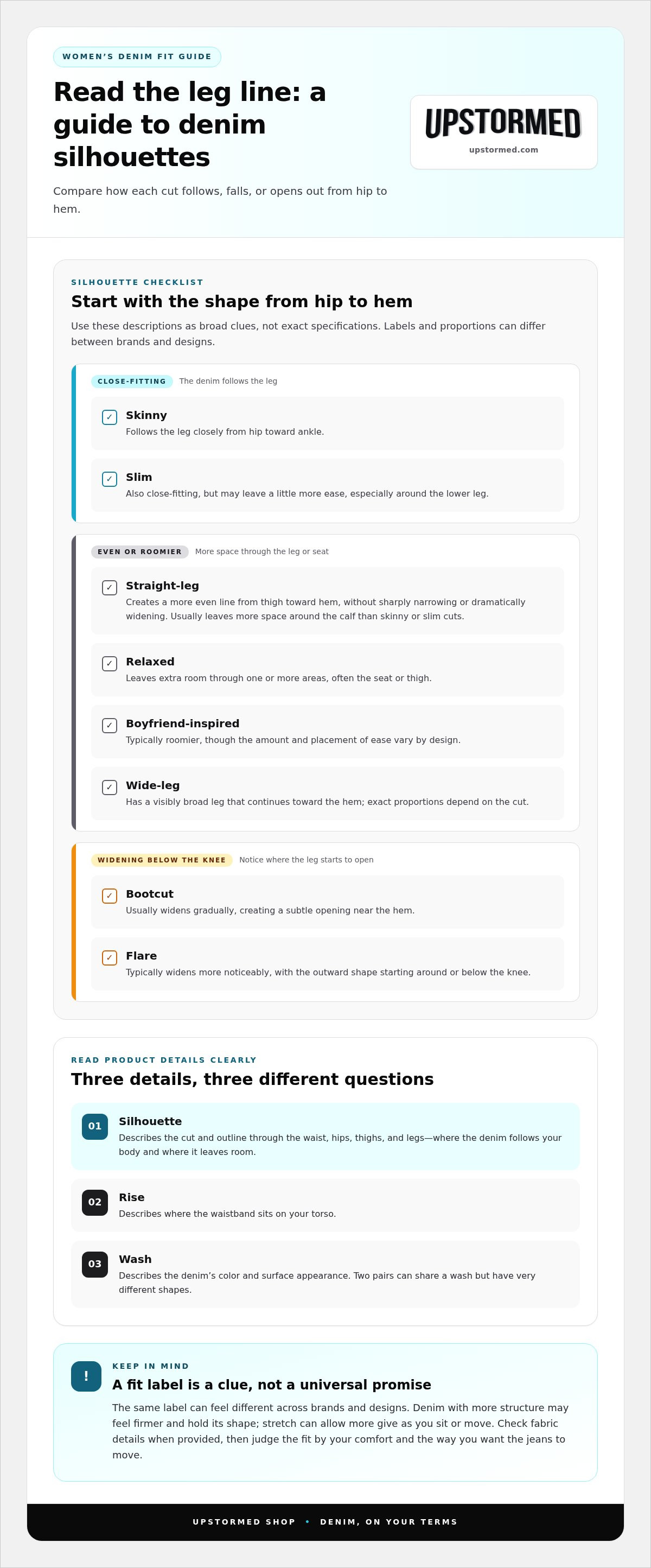
In this women's denim fit guide, “fit” means the garment’s overall cut through the waist, hips, thighs, and legs. It describes where the denim follows your body and where it leaves room. The shape from hip to hem is often called the silhouette. That’s separate from the rise, which describes where the waistband sits, and the wash, which describes the denim’s color and surface appearance.
Think of silhouette as the outline you see from the front or side: a leg may stay close, fall straight, or widen toward the hem. Rise is a separate detail that affects where the waistband rests on your torso. Wash is about appearance, from a deep blue tone to a lighter, more faded look. Two pairs can share a wash but have very different shapes, or share a silhouette and look distinct in different washes.
That distinction helps when scanning a product page. Separate the details: “straight leg” describes the cut, “mid-rise” gives a clue about waistband placement, and “dark wash” describes the finish. The words work together, but they answer different questions. For background on how jeans evolved from workwear into a fashion staple, explore the History of Jeans and Denim.
Labels give you a starting point, not a promise that two pairs will feel identical. A “straight” cut generally signals a leg that doesn’t dramatically taper or flare, but the exact shape through the hips, thighs, and hem can vary by brand and design. Even within one label, proportions may differ. Your preference matters too: one person’s comfortable ease may feel roomy to someone else.
Fabric also changes the experience. Denim with more structure may hold its shape and feel firmer, while stretch can allow more give as you sit or move. Neither automatically makes a pair better. The difference is how the material feels to you and how you want your jeans to move. Check the product details for fabric information when provided, then use the fit label as a guide rather than a verdict.
A fit name describes a design direction, not a universal sizing promise. Keep that in mind as you browse. Compare the words, look at the garment’s outline, and let your comfort make the final call. The label starts the search. Your experience finishes it.
Fit names become useful visual clues once you know what to look for. Picture the jeans from hip to hem: do they stay close to the leg, fall in a steady line, or open outward? That outline affects the look of an outfit and how much room you have to move. No silhouette is a rule. It’s a choice about shape and ease.
Skinny jeans follow the leg closely from hip toward ankle. Slim jeans also have a close outline, but may leave a little more ease, especially around the lower leg. Brands don’t always draw the line between those labels in the same place, so treat them as broad descriptions rather than exact specifications.
Straight-leg jeans create a more even line from the thigh toward the hem. The leg opening generally doesn’t narrow sharply or widen dramatically, giving the cut a balanced outline. Compared with a close-fitting skinny or slim style, straight legs usually leave more visual and physical space around the calf. The difference is noticeable in movement, too: one feels closer to the leg, while the other lets the fabric fall with a little more room.
Relaxed jeans have extra room through one or more areas, often the seat or thigh. Boyfriend-inspired cuts are also typically roomier, but the amount and placement of that ease vary by design. Wide-leg jeans make a bolder shape, with a visibly broad leg that continues toward the hem. The result can feel open and easy, though the exact proportions depend on the cut.
Bootcut and flare both widen below the knee, but the change differs. A bootcut usually opens gradually, creating a subtle widening near the hem. A flare typically becomes wider more noticeably, with the outward shape starting around or below the knee. Look at where the leg begins to expand to distinguish them in a product photo.
A denim silhouette traces its own path from hip to hem, close, steady, roomy, or widening. Use that line as a quick comparison tool. Imagine the fabric around your thigh, knee, and ankle, then consider whether you want a close outline or more space. Denim has moved from practical workwear to an enduring fashion staple, as Levi Strauss & Co. recounts in The Origins of Blue Jeans and Denim. Today, familiar cuts offer plenty of ways to make the look your own.
If you’re looking for a closer-fitting style, explore Upstormed Shop's women’s jeans, including Ripped Slimming Jeans For Women. Use the silhouette as a starting point, then consider what feels comfortable as you move.
No single denim silhouette is the one everyone must wear. A pair can look polished on one person but feel restrictive to them, while another cut may feel freeing and more like their style. “Flattering” isn’t a universal rulebook. Your comfort, movement, and preferred look are more useful guides.
Use this women's denim fit guide to explore, not as a test you have to pass. Start by naming the feeling you want from your jeans. Do you like a close outline, more space through the leg, or a shape that widens toward the hem? Those preferences can help narrow your search without putting your body into a category.
These pairings are prompts, not prescriptions. Think about the outline and ease you’d enjoy, then use the suggestions to choose styles to compare.
| What you want | Silhouettes to explore | What to notice |
|---|---|---|
| A close, defined feel | Slim or skinny | How closely the leg follows your shape |
| More ease and room | Relaxed or wide-leg | How much space you want through the leg |
| A steady leg line | Straight | Whether you like a consistent outline toward the hem |
| A leg that opens out | Bootcut or flare | How subtle or pronounced you want the widening to look |
Consider the day ahead, too. If you’ll be sitting, walking, and moving around, compare how each cut feels through those activities, not just in a mirror while standing still. A close silhouette might feel neat to you, or you might prefer more room. A straighter line may feel familiar; a wider leg may make an outfit feel more relaxed. There’s no wrong answer.
Try sitting down, taking a few steps, and bending your knees. Notice whether the waistband, hips, thighs, and knees feel comfortable rather than distracting. Then ask whether you like the shape you see. Advice about what suits a particular body shape can’t account for your preferences, plans, or the way you want to show up.
The most useful fit is the one that feels comfortable and feels like you. That’s the standard worth keeping. A guide from denim maker Candiani also explores choosing a denim fit, but your own experience remains central. The same cut may feel different depending on the garment and the wearer. Treat any chart or style suggestion as a starting point, then trust what feels right on your body.
Ready to continue your search? Explore Upstormed’s women’s jeans and let comfort, not a body-type rule, lead the way.
A pair of jeans can look promising on a hanger or screen, then feel different the moment you sit down. Give each candidate a quick movement test before deciding. This women's denim fit guide turns the try-on into a practical check, whether you’re in a fitting room or trying jeans at home.
Start with how the denim feels, not whether it matches a styling rule. Move through these checks in order, noticing what feels comfortable and what keeps pulling your attention.
Online, start with the individual product page. Read its fit description instead of assuming a label means exactly the same thing across brands. Look for the garment’s size guidance and fabric details, if provided. You can compare the guidance with a familiar pair you own, keeping in mind that different cuts and materials may feel different even when their labels look similar.
Before ordering, read the retailer’s stated return terms so you understand your options if the fit isn’t right. Don’t rely on a photo alone to predict comfort. Product details, fit notes, and a clear idea of how you want the jeans to feel can help you make a more informed choice.
Fit is something you experience, not something you have to guess perfectly on the first try. Trust what you notice at the waist, through the hips and thighs, and as you move. Ready to browse? Explore Upstormed’s women’s jeans and use these checks to guide your search.
You’ve explored the shapes, compared what you want from a silhouette, and considered how jeans feel in motion. Now let your own preferences have the final say. Trends can offer ideas, but they don’t get to decide what belongs in your wardrobe. Choose the outline, ease, and overall look that feel like you.
Personal style is reason enough. Maybe you reach for a close-fitting look, enjoy the ease of more room, or want a leg shape that stands out in an outfit. Those choices don’t need to follow rules about your body. Your comfort and taste are the point.
Think about where you’ll wear your jeans and what you like pairing them with. The same silhouette can feel casual with a favorite tee or more considered with a crisp shirt. Notice which shapes make getting dressed feel easy and which ones you enjoy seeing in the mirror. You don’t need to defend your choice. You only need to feel good wearing it.
The product name alone can’t tell you every detail of how a pair will feel. Use the item’s description and available size information, then rely on your comfort as you decide. A confident choice doesn’t have to be complicated. It just has to feel right for you.
Upstormed Shop’s women’s apparel includes a women’s jeans category, with Ripped Slimming Jeans For Women among its listed products. It’s a place to continue browsing after deciding what matters to you in denim. Keep your fit preferences in mind and use the product information to guide your decision.
This women's denim fit guide isn’t about finding one perfect cut for everyone. It’s about asking better questions: Do I feel comfortable standing and sitting? Can I move easily? Do I like the silhouette and how it fits my style? Those answers matter more than a trend label or someone else’s rules.
Trust what you’ve learned and choose with confidence. Browse Upstormed Shop’s women’s apparel to explore its clothing, including women’s jeans. Your style is yours to shape, one thoughtful choice at a time.
Your next pair of jeans doesn’t need to complete a checklist or prove anything. Let it be a choice that feels good in your real life, whether you’re heading out for a full day or keeping things easy. Style can shift with your plans. Your confidence doesn’t have to wait for permission.
Keep this women's denim fit guide in mind as you browse, but leave space for instinct, too. Notice the pieces you’re drawn to. Imagine how you’d wear them, then choose what feels true to your taste. There’s freedom in dressing for yourself, not for a rule that was never yours to begin with.
Ready for your next find? Explore Upstormed's women's apparel and take the next step toward a wardrobe that feels like you. Trust your eye, trust your comfort, and wear your choice with confidence.
The right fit is the one that works for your comfort and the way you like to dress. Start with a real outfit or occasion in mind, such as a long day on your feet or a casual evening out. Then compare a couple of silhouettes and ask which one you’d reach for again. This women's denim fit guide is a starting point, not a rulebook.
Slim-fit jeans usually follow the leg more closely, while straight-leg jeans maintain a more even outline from thigh toward hem. For a quick visual comparison, lay each pair flat and look at how much the leg narrows below the thigh. That can help distinguish the shapes in product photos, though the amount of taper varies by design and brand.
Wide-leg jeans can work well for everyday wear if you enjoy extra space through the leg and the particular pair feels easy to move in. Consider your usual routine: if you often climb stairs or walk briskly, notice whether the fabric feels manageable as you move. The hem and shoes you plan to wear can also affect how practical the overall outfit feels.
Yes, you can wear skinny jeans if you like them, even if relaxed cuts are usually your preference. Style is yours to shape. If you want a more laid-back outfit, pair close-fitting jeans with a roomy shirt, sweater, or jacket. You can also keep relaxed styles in rotation for days when you want more space. There’s no need to choose just one silhouette.
Jeans should feel comfortable enough for you to sit without the waistband digging in or the fabric creating strong pulling across your hips or thighs. A little change in tension as you bend is normal, but pinching or needing to keep adjusting can signal that this pair isn’t comfortable for you. Try sitting as you normally would, rather than holding a posed position.
A size label is only one part of fit. Brands can use different patterns and proportions, while fabric structure and stretch affect how a pair feels on your body. Even two jeans with similar labels may sit differently at the waist or have different ease through the thigh. Treat each product’s size information as specific to that garment instead of assuming your usual size will feel identical everywhere.
Read the individual product’s fit notes and size guidance, then look for fabric details and garment measurements if provided. Comparing those details with a pair you already own can give you a useful reference, especially if you check the same areas, such as waistband and leg width. Before ordering, review the retailer’s stated return terms so you understand your options if the jeans aren’t right for you.

Article by
Jonathan Anthony Burkett
Jonathan Anthony Burkett was born in 1987. He is a bright writer inspired by many, as he continues to struggle in life. Devoted for achievement in his lifetime, he is willing to take any test. He told himself, that he would never give up no matter the trials and tribulations. He decided to write to help him move towards a bright future for himself; and because he knows that s what his Grandparents want for him.
Learning now that life is a challenge for many, with trials, tribulations, brutality, hatred, along with grief and manipulation. Jonathan is writing now to release his thoughts about life, after being motivated, inspired to prosper, encouraged to tolerate, uplifted, and empowered from his past.

A September research announcement revisits BASE-STEP’s March 2026 antiproton transport. The scien...

Ahead of November 3, UNESCO’s 2026 designations offer a way to read conservation, livelihoods and...

Following the October 21–25 edition in Las Palmas de Gran Canaria, consider how a clip, artist pr...

 Account
 Cart