

11 Nov
2026
Quick Summary
Music and reading for mental clarity works for some people and not others, so the best approach is to test it yourself. Calm, instrumental music with low volume often suits demanding text, while lyrics tend to compete with words on the page. A two-week controlled self-test comparing silence, instrumental and vocal music gives you a personal answer.
Music and reading for mental clarity is a question many people ask, and the honest answer is that the evidence is mixed. Music can improve mood and reduce stress for some people, which may make sustained reading easier. Whether it sharpens comprehension depends on the music, the task and the person.
Many readers find that a calm, familiar background helps them settle in. Others find the same sound pulls their attention away from the page. Those two outcomes are both common, and that is the real story.
For a fuller look at how music connects to resilience and emotional focus, see music for resilience and adversity.
The right music depends on what you are reading. A dense textbook chapter asks more of your working memory than a light novel. Match the audio to the demand.
For demanding material, most readers do better with quiet, steady sound. For lighter reading or long sessions where you need to stay motivated, a warmer, more uplifting track may help. Think of music as a dial you adjust, not a fixed habit.
A common mistake is choosing one playlist for every task. Try a simple rule: harder text, simpler sound. Easier text, more feeling is allowed. If you want more on pairing your reading with motivation, explore finding motivation in literature and music.
Lyrics are the main reason music can hurt reading. Your brain processes spoken or sung words in the same language areas it uses to read. When both streams carry meaning, they can crowd each other.
This is why many people choose instrumental music for reading sessions. Without words, the sound stays in the background and leaves your language processing free for the page.
Vocal music is not off limits. Some readers handle songs in a language they do not read well, or songs they already know by heart, without trouble. Test it for yourself.
Most advice on music and reading stops at "try it and see." A controlled self-test turns that vague suggestion into data you can act on. The goal is to compare reading comprehension, recall, and perceived effort across three conditions, silence, instrumental music, and vocal music, using the same kind of text each time so the only variable that changes is the audio.
What you need: a notebook or spreadsheet, a timer, three comparable reading passages per condition (nine total), and a pair of headphones you already know well. Keep the room, chair, lighting, and time of day as consistent as you can across sessions.
Step 1, Build matched passage sets. Choose nine passages of similar length and difficulty from the same source or genre. A practical rule: dense nonfiction (technical chapters, academic papers, long-form analysis) counts as hard; narrative nonfiction, essays, and literary fiction count as medium; light fiction, news features, and how-to articles count as easy. Do not mix difficulty levels within a set, or you will be measuring the text, not the music.
Step 2, Run three sessions per condition. For each condition (silence, instrumental, vocal), read one passage for 25 minutes with a 5-minute break between sessions. Use the same volume setting for both music conditions, low enough that you can hear a page turn. Log the start and end time.
Step 3, Measure three things right after each session. First, write a three-sentence summary of the passage from memory without looking back. Second, answer five recall questions you wrote for yourself before the session (dates, names, key claims, the main argument). Third, rate perceived effort on a 1-to-10 scale, where 1 is effortless and 10 is exhausting.
Step 4, Score and compare. Give each summary a 0-3 score: 0 for missing the main point, 1 for partial, 2 for accurate but thin, 3 for accurate and complete. Add the recall-question score (0-5). You now have a comprehension score out of 8 and an effort score out of 10 for every session. Average the three sessions per condition.
Step 5, Read the pattern, not a single session. A meaningful difference is roughly one point or more on the 8-point comprehension score, or two points or more on the effort scale, sustained across all three sessions. Anything smaller is noise. If instrumental music beats silence on comprehension and effort for hard text, that is your default for hard text. If vocal music only helps on easy text, restrict it there.
Watch out: if your summaries get shorter and your effort scores climb in the music conditions, the audio is probably too busy or too loud, drop the volume by two notches and rerun one session before concluding music does not work for you.
This is the same logic a reading specialist would use: hold the text constant, change one variable, and measure comprehension and effort separately. It takes about two weeks of short sessions and gives you a personal answer instead of a generic one.
The self-test runs over about two weeks, and each step has a clear output you can record and compare across conditions.
| Step | What to do | Time or frequency |
|---|---|---|
| Step 1, Build matched passage sets | Choose nine passages of similar length and difficulty | Before starting |
| Step 2, Run three sessions per condition | Read one passage for 25 minutes per condition | 25 min, 5 min break between sessions |
| Step 3, Measure right after each session | Write a three-sentence summary, answer five recall questions, rate effort | Immediately after each session |
| Step 4, Score and compare | Score summary 0-3, recall 0-5, average per condition | After all sessions |
| Step 5, Read the pattern | Look for a difference of about one point or more across all three sessions | Across all three sessions |
Three features shape how music affects focus: tempo, volume and complexity.
Slower tempos around 60 to 80 beats per minute suit most reading. Fast, driving beats often pull attention toward the rhythm. Keep volume low enough that you can hear your own thoughts. Sound that is too loud forces your brain to work harder to filter it out. Choose simple arrangements with few layers. Dense, shifting textures ask more of your attention than a steady pad or soft piano.
These are starting points, not rules. Adjust each one during your self-test and keep what helps.
This method is built around one idea: match the audio to the reading task, then adjust one variable at a time. It works for a dense textbook chapter, a novel, and a proofreading pass, but the settings differ for each.
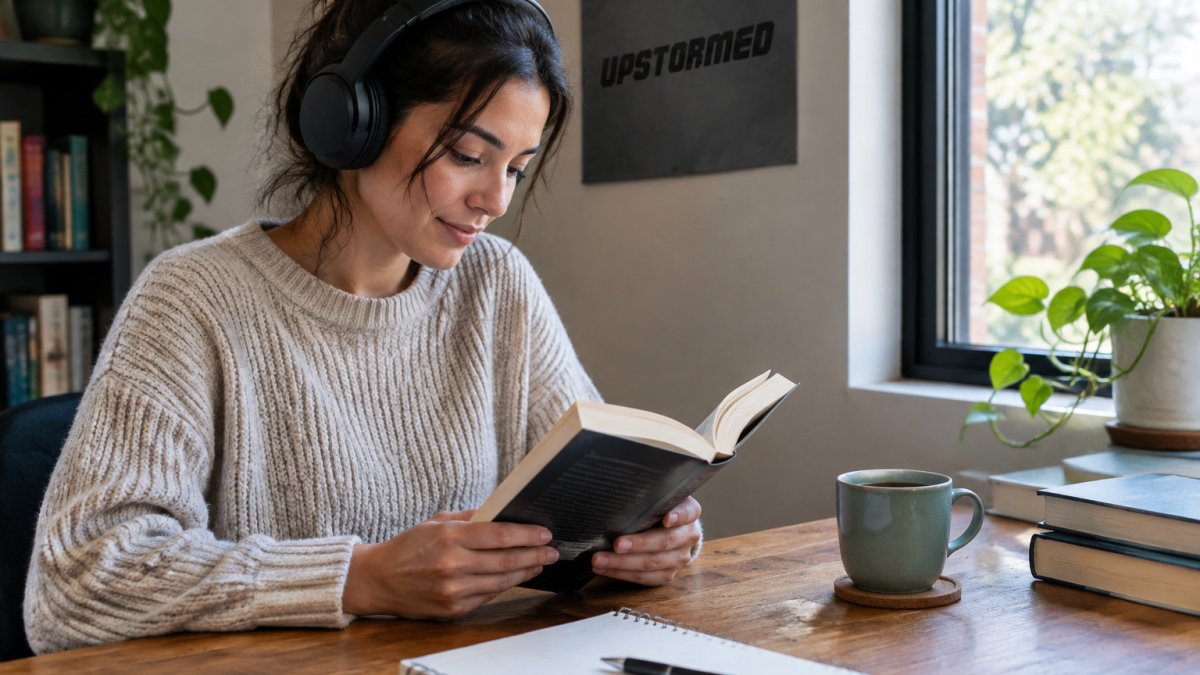
Step 2, Choose the audio profile for the bucket. For dense nonfiction, pick instrumental tracks with a steady tempo around 60-80 beats per minute, few layers, and no sudden dynamic shifts, soft piano, ambient pads, or minimal electronic. For narrative reading, you can allow light vocals or familiar songs, but keep them in a language you do not read in if lyrics distract you.
Step 3, Set volume and headphones deliberately. Use over-ear headphones rather than earbuds if you tend to raise volume to compensate for room noise. Set volume so that a page turn or a pen tap is clearly audible, that is roughly the level where music stays background. Keeping music low enough to hear the room also matters when choosing sleep headphones for audiobooks, since comfort and a restrained volume help preserve a quieter listening experience.
Step 4, Run a 25-minute block with one job. Start a timer, silence notifications, and read without checking your phone. If you notice you have reread the same paragraph twice, that is the signal to change one variable, not to push through. The usual fix is lower volume or a simpler track, not a new genre.
Step 5, Close the loop with a two-minute summary. After the block, write three sentences on what you just read and rate your focus 1-10. This is the same measurement you use in the self-test, so the two sections reinforce each other.
Step 6, Adjust exactly one variable next session. Change tempo, volume, or genre, never all three. If focus improved, keep the change; if not, revert it. Over four or five sessions you will converge on a setup that fits your reading task and your attention style.
Watch out: if you find yourself reaching for the volume dial or skipping tracks mid-session, the music is doing more work than the page, stop the session, switch to silence for the rest of the block, and treat that as data for your next adjustment.
For readers who want a starting catalog rather than a blank playlist, the Upstormed Records music catalog and the music page list instrumental and low-distraction options you can test against this method.
Your environment matters as much as your playlist. Use headphones or speakers placed away from your reading spot, and keep notifications off while you read.
When you are ready to explore options, browse the Upstormed Records music catalog for tracks with a steady, meaningful feel. You can also visit the music page to see the full selection of Jonathan Anthony Burkett's albums and EPs, including One Life, Changes, Born To Make It and the Life As I Know It EP.
For the broader case for music with a message, read why music with a message still matters.
Background music can mask distracting noise and create a steady sensory baseline, which some people find helps them stay on task. The effect varies from person to person. People who are easily distracted by silence or by their own racing thoughts often report benefits, while people who are highly sensitive to sound may find any music disruptive. The practical test is simple: read a passage in silence, read a similar passage with your chosen audio, and compare how well you recall the content afterward.
For tasks that demand heavy language processing, such as reading dense text or learning new terms, silence or quiet instrumental audio usually works best. For routine or familiar reading, low-volume instrumental music can help maintain attention. Lyrics compete with the words on the page, so they are the most common cause of reduced comprehension. Run a short comparison of silence and your preferred music on the same material to see which gives you better recall and less mental fatigue.
Yes, for many readers. Vocal music activates the same language processing that reading requires, so the two can interfere with each other. Instrumental music, ambient soundscapes and familiar background tracks you no longer listen to closely are generally less disruptive. If you want vocals, try them on lighter tasks first and notice whether you need to reread sentences more often.
Keep the volume low enough that you can hold a conversation without raising your voice. Music that is loud enough to notice on its own tends to pull attention away from the text. Start at a low level, increase it gradually, and stop at the point where you first notice the music rather than the reading. Pay attention to fatigue as well, since high volume over long sessions can make concentration harder rather than easier.

Learn how to style a midi dress for day to night with shoes, layers, bags and jewelry swaps. A pr...

Activewear trends 2026 bring sculpting fits, soft layers, expressive color, and real-world versat...

Personal strength grows through small daily habits, mindful clothing choices and self-love practi...

 Account
 Cart
